
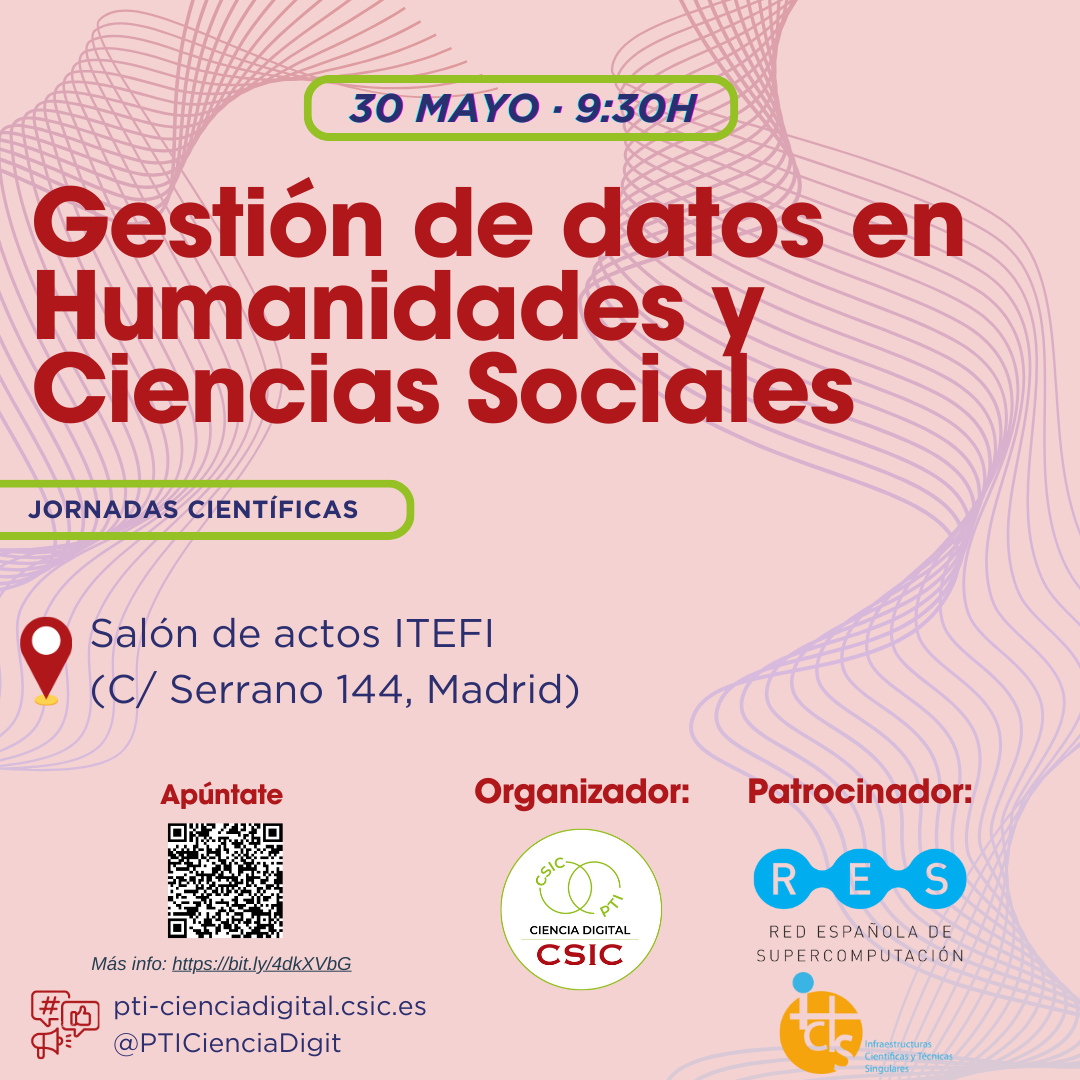
Data Management in the Humanities and Social Sciences
Artificial intelligence (AI), natural language processing (NLP), data analysis, text mining, digital editing, and digital mapping, among others, are disciplines closely connected to Digital and Open Humanities and Social Sciences. Today it is difficult to find research projects in the Humanities or Social Sciences in which data do not play a central role. This requires preparing data management plans, creating appropriate structures to collect data, developing infrastructures that enable data processing and visualization, making data FAIR, ensuring long-term storage, and more. All these processes call for multidisciplinary teams that include data-management specialists, software engineers, linguists, archaeologists, sociologists, demographers, and others.
This event was organized within the framework of the CSIC’s Interdisciplinary Thematic Platform (PTI) for Digital Science, whose mission is to innovate across all areas of digital science and data lifecycle management, from planning, acquisition, and processing to publication and preservation. The PTI focuses on innovation in areas with economic and social impact, particularly in fields such as health and well-being, agriculture, climate, and societal security. It also aims to promote digital training to support everyday tasks. Its activities are organized into four strategic areas and two cross-cutting areas that integrate various initiatives.
On 30 May, we addressed the role of supercomputing technologies in data management for the Humanities and Social Sciences in Madrid.
The event took place on Thursday over the course of the entire day. It began with a presentation of the Spanish Supercomputing Network (RES), the event’s sponsor, delivered by Alberto Luna (CCC-UAM), followed by a presentation of the PTI Digital Science, the organiser and sponsor. After these introductory talks, a series of presentations explored supercomputing technologies in the Humanities and Social Sciences from a general perspective. The following talks were given:
- Institutional repositories and research data management, by Sylvia Fernández (Tomás Navarro Tomás Library, CCHS-CSIC)
- Data ethics, by Laura Barrios (SGAI, CSIC)
- Data geolocation in the Social Sciences, by Diego Ramiro (IEGD, CSIC)
- Linked data and data spaces, by Pablo Calleja (UPM) and Sonia Jiménez (Tomás Navarro Tomás Library, CCHS-CSIC)
In the afternoon, practical case studies were presented to explore potential collaboration paths between the Social Sciences and supercomputing. This session was important because another objective of the event was to highlight the role that supercomputing can play in processing and computing capacities for unstructured data—an urgent need in the Humanities and Social Sciences. The afternoon sessions were delivered by:
- Begoña Aguado (CBMSO, CSIC)
- Leonardo Campillos (ILLA, CSIC)
- Antonio Cea and Pilar Martínez del Olmo (ILLA-BTNT, CSIC)
- Ana Crespo Solana (IH, CSIC)
- Judith Farré Vidal (ILLA, CSIC)
- Elea Giménez (ILLA, CSIC)
- Arturo Guerrero and Teresa Madrid (ILC, CSIC)
- Ana Rodríguez (IH, CSIC)
- Consuelo Sendino (MNCN, CSIC)
- Jan Thiele (ILC, CSIC)
The event was very well received due to the quality of the presentations, and it was highly productive, as several new lines of collaboration were initiated.